Introduction
Most real estate marketing teams are not short on ideas. They are short on execution speed, and specifically on how fast a new lead gets a real response.
The average agent takes over 15 hours to respond to a new lead. Leads contacted within 5 minutes are far more likely to qualify than leads contacted after 30. That gap is what most of the tools in this comparison exist to close, not “AI” as a buzzword, but faster, more consistent follow-up.
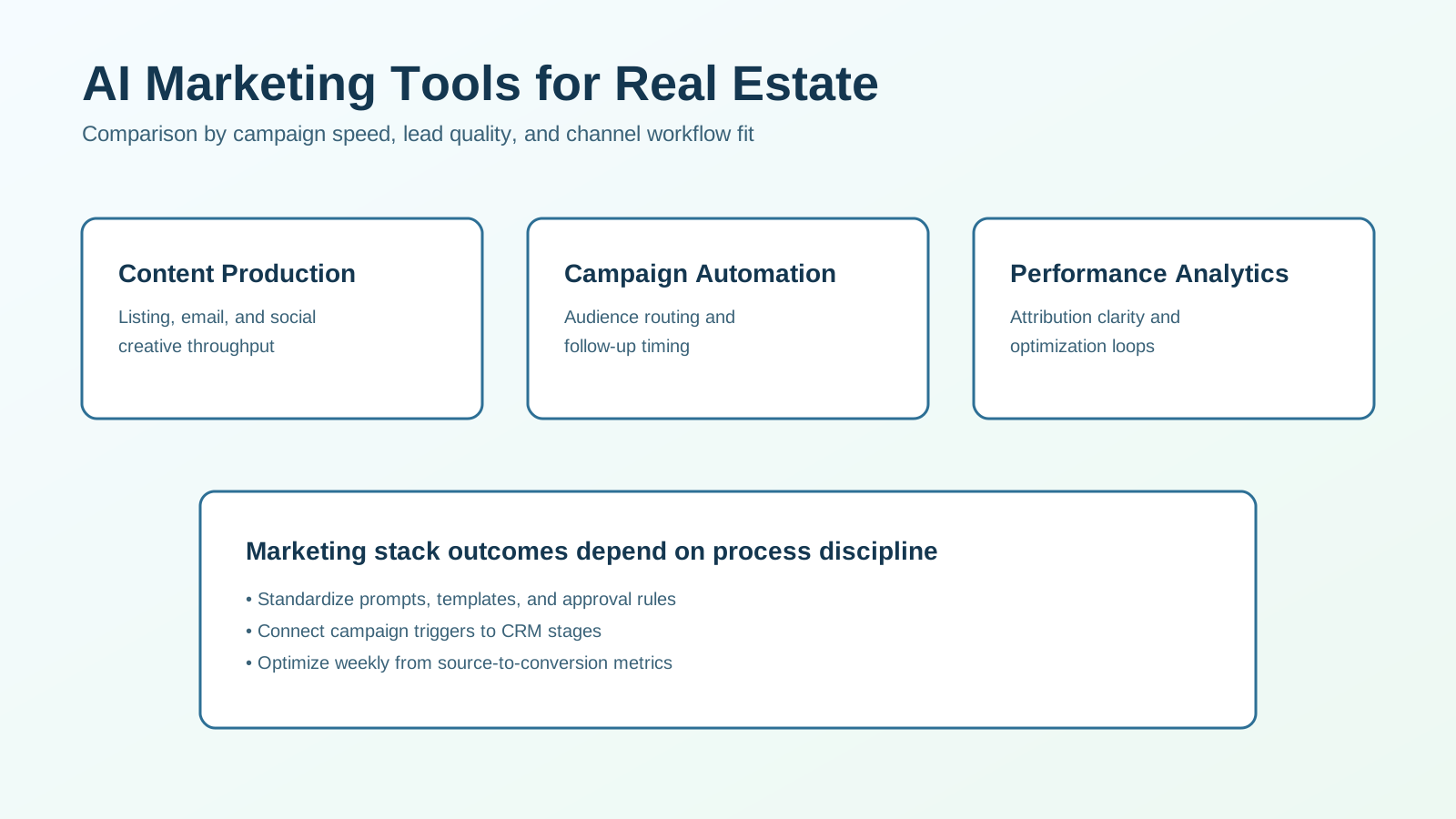
This guide names actual platforms, what each one costs, and where each fits, instead of describing abstract tool “categories.” If you want the operating model first, start with Real Estate Marketing Automation.
What This Comparison Covers
- conversational lead qualification (AI that talks to leads),
- full-funnel platforms (ads plus automated follow-up),
- predictive seller identification,
- CRM and transaction coordination,
- content and listing copy,
- where a self-hosted automation layer (n8n) replaces some of the above.
Quick Recommendation
If you only fix one thing: fix response time. A $20/month ChatGPT Plus subscription for listing copy pays for itself on the first listing. A $150/month conversational AI tool for lead response usually pays for itself faster than a $2,000/month all-in-one platform, because most of that $2,000 is ad spend and reach you may not need yet.
Conversational Lead Qualification
These tools talk to a new lead by SMS, chat, or voice within seconds of them showing interest, then hand off to a human once the lead is qualified.
- Structurely (around $150/month): an AI inside-sales agent, marketed as “Aisa Holmes,” that runs SMS, email, web chat, and voice follow-up with a 12-month nurture sequence. Integrates with Follow Up Boss and kvCORE. Good fit for solo agents and small teams who need faster response without hiring an ISA.
- Perspective AI: website chat that qualifies a visitor conversationally instead of a static contact form.
- Roof AI: a 24/7 chat assistant for brokerage websites that routes qualified visitors to the right agent.
Watch-out: none of these create motivated buyers or sellers out of nothing. They respond to existing interest faster than a human can, or surface people worth calling sooner.
Full-Funnel Platforms (Ads + Follow-Up Bundled)
- Ylopo (roughly $600–$2,000+/month before ad spend): combines paid digital advertising with automated voice and text follow-up over a lead’s first 90 days.
- CINC: similar bundled model, ads plus its own conversational layer (“Alex”).
Best fit: teams with an actual ad budget who want the advertising and the follow-up under one roof. Weak fit for a solo agent just starting out, the fixed cost is hard to justify before you have lead volume to match.
Predictive Seller Identification
These tools do not talk to leads, they score homeowners in your farm area on likelihood to sell in the next 6-12 months, using public records and behavioral data.
- SmartZip and Top Producer’s Smart Targeting: the two most established names in this category.
- Offrs, Fello, Revaluate: alternatives, usage-based pricing that can start under $50/month, scaling to $250-500+/month depending on farm size.
Best fit: agents who already have a listing pipeline problem, not a lead-response problem.
CRM and Transaction Coordination
- Follow Up Boss and Lofty (formerly BoldTrail): the two most common CRMs the tools above integrate with natively.
- kvCORE: common in team and brokerage setups.
If your team is managing 5+ agents and lead routing is inconsistent, this layer is usually the actual bottleneck, not marketing content.
Content and Listing Copy
- ChatGPT Plus / Claude (~$20/month): the highest-ROI single line item on this list if you write any listing descriptions, emails, or CMA summaries yourself. Does not integrate with MLS directly, but a simple webhook can pass listing data in and copy out.
- REimagineHome and similar AI virtual staging tools: for empty or dated listing photos.
Where a Self-Hosted Layer (n8n) Fits Instead
Most of the “glue” work between these tools, moving a new lead from a form into a CRM, tagging it, notifying the right agent, triggering a follow-up sequence, does not require a $600-2,000/month suite. It can run on n8n, self-hosted, connecting your CRM, calendar, and messaging channels with workflows you control directly instead of paying platform fees for orchestration you could own.
The tradeoff is honest: an off-the-shelf tool like Structurely gives you a tuned conversational AI out of the box. n8n gives you the routing, notification, and CRM-sync logic without the subscription, but you still need a real conversational or predictive tool behind it for the parts that require an actual AI model talking to a lead.
Practical split that works for a lot of small teams:
- keep one specialist AI tool for the part that actually needs to “think” (a Structurely or a ChatGPT-based listing copy flow),
- run everything else, routing, CRM updates, notifications, reporting, on a self-hosted n8n instance.
This keeps fixed monthly cost low and keeps you from paying suite pricing for logic you can run yourself.
Cost Reality
| Layer | Typical cost | Notes |
|---|---|---|
| Content (ChatGPT/Claude) | ~$20/month | Fastest payback on this list |
| Conversational AI (Structurely, Perspective AI) | ~$150/month | Pays for itself by fixing response time |
| Predictive seller ID (SmartZip, Offrs, Fello) | $50-500+/month | Usage/farm-size based |
| Full-funnel suite (Ylopo, CINC) | $600-2,000+/month + ad spend | Only worth it once lead volume justifies it |
| Self-hosted automation (n8n) | Server cost only, no per-seat fee | Requires setup time, not plug-and-play |
If output volume goes up but consultation bookings do not, the problem is usually response time or lead routing, not a missing tool.
Common Mistakes
Buying the suite before the volume. A $2,000/month platform makes sense once you have the lead flow to use it, not before.
No real integration check. “Integrates with Zapier” is not the same as a native two-way CRM sync. Confirm it before you commit to annual pricing.
Measuring content output instead of response time. More listing descriptions per week does not fix a 15-hour lead response gap.
Frequently Asked Questions
What are the best AI marketing tools for real estate?
Structurely and Perspective AI for conversational lead qualification, Ylopo and CINC for full-funnel ads plus follow-up, SmartZip and Offrs for predictive seller targeting, Follow Up Boss or Lofty for CRM. Most agents combine two to four of these.
Which tools show ROI fastest?
ChatGPT or Claude for content, immediately. Structurely or a similar conversational tool, usually within the first month, by fixing response time.
Should teams use all-in-one tools first?
Not before you have the lead volume to justify a $600-2,000/month platform. A leaner stack, or a self-hosted n8n layer connecting one or two specialist tools, is often more cost-effective early on.
What should we measure first?
Time from lead arrival to first meaningful response. It predicts qualification rate better than almost any other single metric.
Final Recommendation
Name the actual bottleneck before buying anything: slow response time, weak seller pipeline, or messy CRM handoff are three different problems with three different tools. Start with the cheapest fix for your specific bottleneck (often ChatGPT for content, or Structurely for response time), and only move to a full suite once volume justifies the fixed cost.