Introduction
Most real estate teams are not short on leads. They are short on qualified leads.
Without a structured system, agents spend time on prospects who are not ready while high-intent opportunities wait too long for serious follow-up.
That is why real estate lead qualification automation matters.
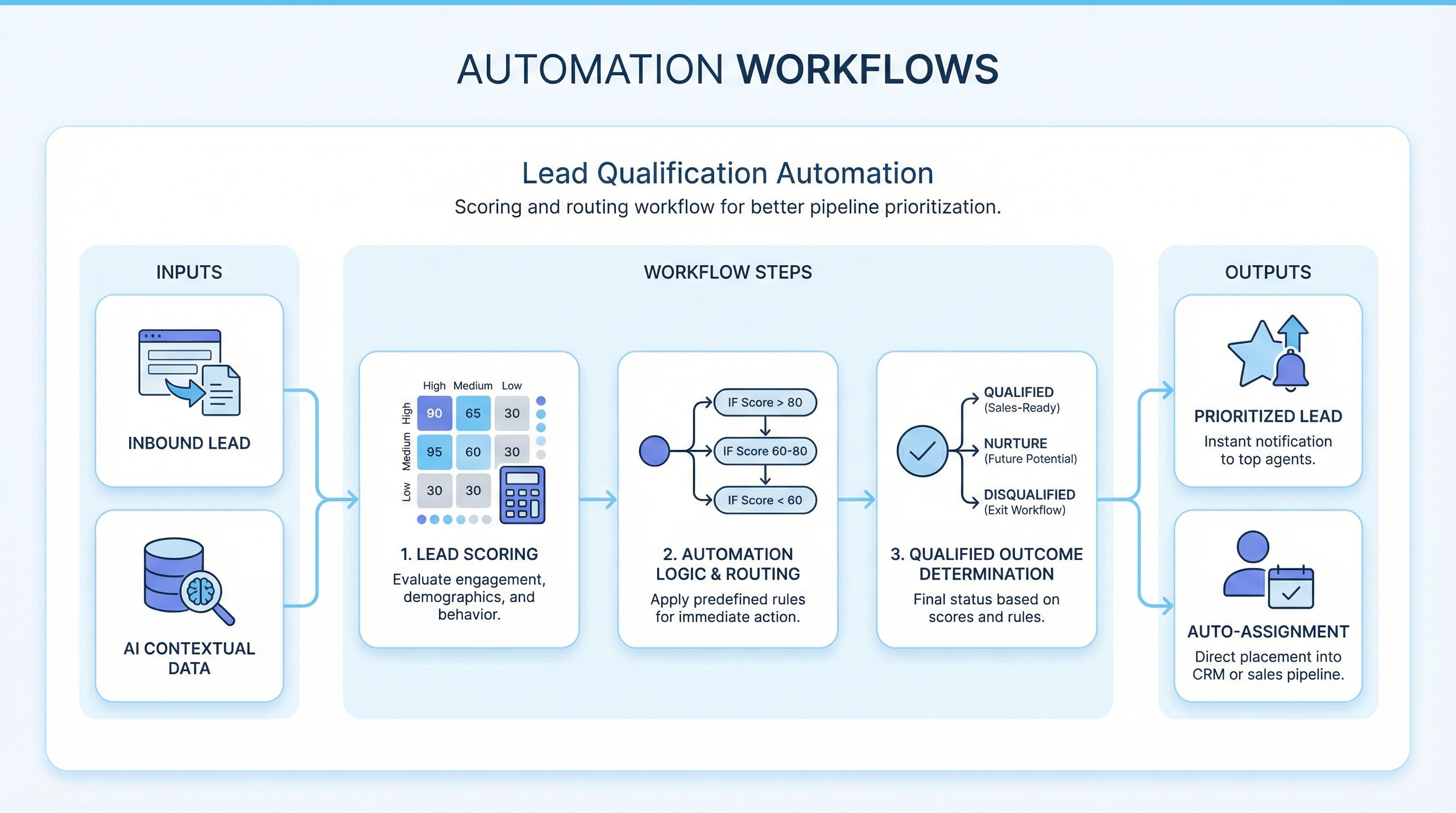
A good qualification workflow does three things:
- captures intent signals quickly,
- assigns a readiness score consistently,
- routes each lead to the right next action.
This guide shows how to build a reliable lead qualification system for real estate teams, with practical rules you can implement in most CRM platforms.
For the bigger operating model around routing, tasking, and stage control, see Real Estate CRM Automation before diving deeper into qualification logic here.
What Lead Qualification Automation Means in Real Estate
Lead qualification automation is the process of evaluating new leads using predefined criteria and automated logic instead of ad-hoc manual judgment.
The goal is not to “disqualify people.” The goal is to match follow-up intensity to true readiness.
A complete system includes:
- intake standardization
- qualification criteria
- lead scoring model
- routing and ownership rules
- stage-based automation
- escalation and reactivation logic
When this is done well, agents spend more time in high-probability conversations.
Why Teams Need This Workflow
Without automated qualification, common problems appear quickly:
- slow responses to serious leads
- inconsistent notes and handoffs
- unclear next actions after first contact
- poor alignment between lead source and follow-up strategy
- reporting that cannot explain conversion performance
Qualification automation improves:
- agent productivity
- pipeline clarity
- speed-to-conversation
- appointment rates
- conversion efficiency
It also creates a shared operating system across the team.
The Qualification Framework: What to Score
Use a practical scoring model built around these signal groups.
1. Intent Signals
- inquiry specificity (generic vs property-specific)
- stated timeline
- requested action (showing, call, valuation)
2. Financial Signals
- pre-approval status (buyers)
- budget clarity
- equity/timing readiness (sellers)
3. Fit Signals
- location and price alignment
- property type match
- timeline realism
4. Engagement Signals
- response speed to outreach
- email replies and clicks
- SMS response behavior
5. Commitment Signals
- willingness to schedule consultation
- willingness to share decision criteria
- multi-step follow-through
Scoring should prioritize behavior over assumptions.
Recommended Lead Scoring Model (Starter)
Keep the first version simple.
Scoring Bands
Hot(70-100): immediate agent actionWarm(40-69): active nurture + scheduled follow-upLong-Term(0-39): low-frequency nurture + periodic re-check
Example Weighting
- timeline urgency: 25 points
- financing/readiness: 25 points
- engagement behavior: 20 points
- criteria clarity: 15 points
- explicit next-step intent: 15 points
Total: 100 points
Use this as a baseline, then calibrate based on your own conversion data.
Workflow Architecture
Build your qualification automation in five layers.
Layer 1: Intake and Enrichment
When a lead enters the CRM:
- normalize source fields
- validate required contact data
- apply lead-type tags (buyer/seller/investor)
- capture initial context from form fields
Optional enrichment can append:
- location metadata
- source campaign data
- historical activity if returning contact
Layer 2: Initial Qualification Trigger
Run within minutes of lead creation:
- send first-touch message
- create immediate call task
- launch short qualification question set
This prevents a lag between intake and signal capture.
Layer 3: Scoring Engine
Assign score automatically based on available signals.
Use both:
- static signals (form fields)
- dynamic signals (reply behavior, engagement events)
Update score whenever meaningful new activity occurs.
Layer 4: Routing and Stage Automation
Based on score band:
Hot-> priority queue + rapid call SLAWarm-> structured follow-up cadenceLong-Term-> nurture track + monthly review
Move stage automatically and alert assigned owners.
Layer 5: Feedback and Re-Scoring
Qualification is not one-time.
Re-score on events such as:
- reply received
- consultation booked
- financing status updated
- timeline changed
Dynamic scoring keeps the pipeline current.
Practical Workflow Blueprint
Step 1: Define Required Qualification Fields
At minimum:
- lead intent type
- timeline range
- preferred location
- financing status (or equivalent seller readiness)
- communication preference
If these are missing, the workflow cannot route effectively.
Step 2: Create a Short Qualification Sequence
Automate a compact sequence across email/SMS/call task:
- Touch 1: confirm inquiry + one intent question
- Touch 2: timeline + area clarification
- Touch 3: readiness checkpoint + next-step invitation
Stop sequence when lead engages live.
Step 3: Apply Scoring Rules
Build clear logic examples:
- replied within 24h: +15
- provided timeline under 3 months: +20
- pre-approved confirmed: +20
- no response after 7 days: -10
- clicked high-intent content: +10
Make rule logic transparent so agents trust the score.
Step 4: Automate Routing
Route leads by score and fit:
- geography
- lead type
- price band
- language
- agent capacity
Routing should assign ownership, create next task, and set due time.
Step 5: Configure SLA Alerts
Example service-level targets:
- Hot leads: call within 10-15 minutes
- Warm leads: same-day contact
- Long-term leads: nurture enrollment within 24 hours
Trigger alerts for missed SLAs.
Step 6: Build Recovery Paths
For stalled leads:
- inactivity timer triggers reactivation message
- no engagement triggers secondary touch owner
- repeated no-response moves to nurture archive segment
This protects pipeline hygiene without deleting future opportunity.
Example Qualification Logic (Buyer)
High-Intent Buyer Pattern
Signals:
- specific property inquiry
- pre-approved status confirmed
- timeline under 90 days
- replies to first follow-up
Workflow action:
- mark
Hot - notify assigned agent and team lead
- auto-create consultation booking task
- pause nurture emails
Mid-Intent Buyer Pattern
Signals:
- clear area preference
- financing uncertain
- timeline 3-6 months
- moderate engagement
Workflow action:
- mark
Warm - enroll in 14-day qualification nurture
- create weekly agent check-in task
Early-Intent Buyer Pattern
Signals:
- broad criteria
- timeline 6+ months
- low early engagement
Workflow action:
- mark
Long-Term - start monthly nurture
- schedule 45-day re-check
This keeps follow-up proportional to readiness.
Example Qualification Logic (Seller)
Score seller leads on:
- equity estimate confidence
- reason for selling clarity
- intended listing window
- urgency indicators (job move, purchase contingency)
- engagement with valuation resources
Automate seller stages such as:
Valuation RequestedPrep PhaseListing Window ActiveLong-Term Seller Nurture
Buyer and seller qualification should not share identical scoring logic.
Automate Real Estate Lead Scoring Without Overengineering
A common mistake is building too many scoring variables too early.
Start with 8-12 signals max.
Guidelines:
- prefer observable behaviors
- avoid subjective manual scoring fields
- review score drift monthly
- retire rules that do not correlate with conversion
Scoring models should be easy to explain in one team meeting.
CRM Implementation Requirements
Your platform should support:
- trigger-based workflows
- conditional branching
- score field calculations
- stage automation
- task/alert creation
- event logging
- reporting by source and score band
If your CRM lacks native scoring, use automation tools to write score updates back into custom fields.
Data Governance and Compliance
Qualification workflows must be responsible.
Set governance rules for:
- consent and opt-out handling
- fair housing-safe communication
- role-based data access
- data retention policies
- audit trail for stage and score changes
Document your qualification policy so everyone follows the same criteria.
Common Mistakes and Fixes
Mistake 1: Scoring Only at Intake
Fix: re-score on engagement and status-change events.
Mistake 2: No Link Between Score and Action
Fix: every score band must trigger a specific next-step workflow.
Mistake 3: Too Many Score Bands
Fix: start with three bands (Hot/Warm/Long-Term).
Mistake 4: Agent Overrides Without Notes
Fix: require reason code when manual stage or score changes happen.
Mistake 5: No Source-Based Calibration
Fix: review conversion by source and adjust scoring weights quarterly.
30-Day Build Plan
Week 1: Define Qualification Strategy
- map current qualification process
- choose initial criteria and score bands
- define SLAs and ownership rules
Week 2: Configure Workflow
- build intake normalization
- configure scoring rules
- automate routing and task creation
Week 3: Test With Sample Leads
- test each branch and edge case
- validate score updates on behavior events
- verify SLA alerts and reassignment rules
Week 4: Launch and Optimize
- launch with dashboard tracking
- monitor score distribution daily
- tune rules based on early conversion signals
Keep first release simple and reliable.
KPIs to Measure Qualification Workflow Quality
Track:
- response time by score band
- consultation set rate by score band
- qualification-to-client conversion rate
- average lead age by stage
- manual override frequency
- source-level conversion after scoring
A good model improves both speed and conversion quality.
FAQ
What is the best starting model for lead qualification automation?
A three-band model (Hot/Warm/Long-Term) with 8-12 scoring signals is usually enough to start.
How often should scoring rules be updated?
Review monthly, calibrate quarterly, and refresh major logic at least every 12 months.
Can lead scoring replace agent judgment?
No. It supports judgment by prioritizing workflow actions and reducing inconsistency.
Should buyers and sellers share one qualification model?
Usually no. Their intent signals and conversion paths are different.
Final Takeaway
High-performing real estate lead qualification automation systems are clear, fast, and measurable.
If your workflow captures intent signals quickly, scores consistently, and routes leads into the right actions, your team will spend less time guessing and more time converting.
If you want help implementing this with your current CRM and lead sources, book a consulting call and we can design a qualification workflow that fits your team capacity.